Less Talk, More Visual Magic
By Aim4theStars | 23 Mar 2026
A beautifully illustrate poster for a jazz festival is not successful just because the illustration is pretty. It is successful if it communicates the name of the festival, the headlining bands, the dates, and the location, all while evoking the cool, improvisational feeling of jazz music, ultimately convincing someone to buy a ticket. The artistic is in service of the communication.
Graphics Design has evolved as a powerful way of sharing ideas, information and messages visually from early symbols and drawings to modern digital designs.
The theory of graphic design explains the principles and rules that guide designers in creating effective visual communication.
New technologies and creative ideas have shaped the way designs are created and used over time.
Meaning of Graphics Design
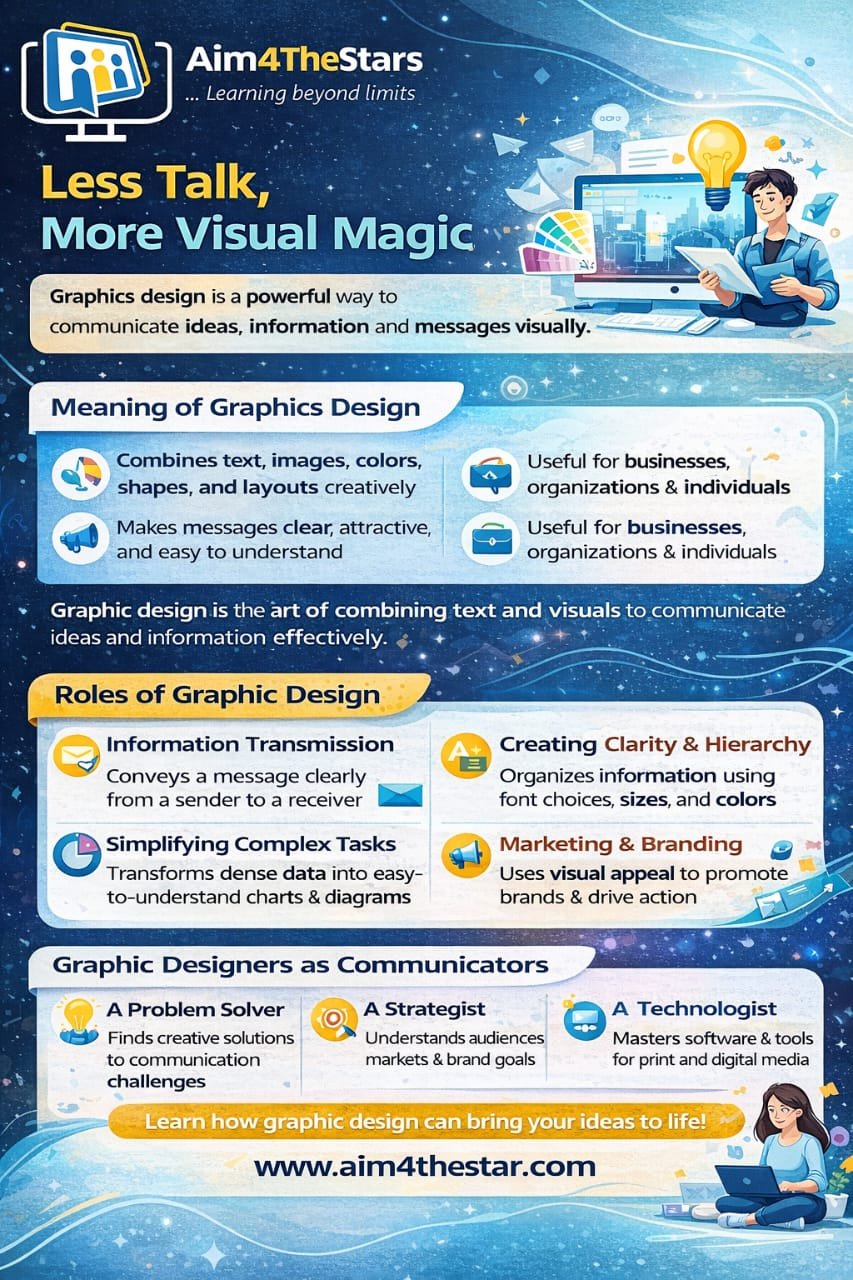
Graphic design is the art and practice of creating visual content to communicate messages, ideas, or information to people. It involves combining text, images, colors, shapes and layouts in a creative and meaningful way so that the message being communicated is clear, attractive and easy to understand.
Graphics Design refers to the process of planning and creating visual elements that help convey information or ideas effectively. Designers use different artistic and technical skills to arrange images, symbols, colors and words in a way that captures attention and communicate a message.
Through graphic design, businesses, organizations, and individuals can present their ideas visually rather than only through words which makes information easier to understand and to be more appealing to the audience.
Graphics design is not just about making things look pretty, it's primary purpose is communication. A designer's success is not by personal attractive preference, but by how effectively their work communicates a specific message to a specific audience and achieves a specific goal.
The Roles of Graphic Design:
Information Transmission:
The role here conveys a message from a sender which is a company, organization, or an individual to a receiver (the target audience).
Creating Clarity and Hierarchy:
Graphic design organizes information which uses font choices, sizes, weight, layout, and color to establish a visual hierarchy. This tells the viewer what to look at first, second, and last, making complex information easily digestible.
Simplifying the Complex Task:
Graphic design plays a critical role in fields like finance, science and technology which take dense data and transform them into easily charts, diagrams and icons.
Marketing, Branding, and Sales:
This is the most commercially visible role of graphic design. It deals with using visual appeal to influence behavior and drive action.
Branding and Identity:
This is a strategic role in graphic design which creates the entire visual identity of a brand like logo design and color palette.
Graphic Designer
As A Communicator:
A Graphic designer translates ideas into a visual language.
A Problem Solver:
Using design thinking to find creative solutions to communication challenges.
A Strategist:
Understanding audiences, markets, and brand goals to create effective work.
An Artist:
This is applying principles of aesthetics, composition, and color theory to design
A Technologist:
Graphic designer master the software and tools needed to bring his designs to life, both in print and digital media.
A Storyteller:
Here, the designer weaves together text and images to create compelling and interesting narratives for the audience
An Advocate:
Using their skills to inform, persuade, and inspire positive change in the society.
Ultimately, the role of graphic design is to bridge the gap between a message and its audience. It gives form to ideas, making them visible, understandable, and impactful in a world filled with information.
Graphics Design has evolved as a powerful way of sharing ideas, information and messages visually from early symbols and drawings to modern digital designs.
The theory of graphic design explains the principles and rules that guide designers in creating effective visual communication.
New technologies and creative ideas have shaped the way designs are created and used over time.
Meaning of Graphics Design
Graphic design is the art and practice of creating visual content to communicate messages, ideas, or information to people. It involves combining text, images, colors, shapes and layouts in a creative and meaningful way so that the message being communicated is clear, attractive and easy to understand.
Graphics Design refers to the process of planning and creating visual elements that help convey information or ideas effectively. Designers use different artistic and technical skills to arrange images, symbols, colors and words in a way that captures attention and communicate a message.
Through graphic design, businesses, organizations, and individuals can present their ideas visually rather than only through words which makes information easier to understand and to be more appealing to the audience.
Graphics design is not just about making things look pretty, it's primary purpose is communication. A designer's success is not by personal attractive preference, but by how effectively their work communicates a specific message to a specific audience and achieves a specific goal.
The Roles of Graphic Design:
Information Transmission:
The role here conveys a message from a sender which is a company, organization, or an individual to a receiver (the target audience).
Creating Clarity and Hierarchy:
Graphic design organizes information which uses font choices, sizes, weight, layout, and color to establish a visual hierarchy. This tells the viewer what to look at first, second, and last, making complex information easily digestible.
Simplifying the Complex Task:
Graphic design plays a critical role in fields like finance, science and technology which take dense data and transform them into easily charts, diagrams and icons.
Marketing, Branding, and Sales:
This is the most commercially visible role of graphic design. It deals with using visual appeal to influence behavior and drive action.
Branding and Identity:
This is a strategic role in graphic design which creates the entire visual identity of a brand like logo design and color palette.
Graphic Designer
As A Communicator:
A Graphic designer translates ideas into a visual language.
A Problem Solver:
Using design thinking to find creative solutions to communication challenges.
A Strategist:
Understanding audiences, markets, and brand goals to create effective work.
An Artist:
This is applying principles of aesthetics, composition, and color theory to design
A Technologist:
Graphic designer master the software and tools needed to bring his designs to life, both in print and digital media.
A Storyteller:
Here, the designer weaves together text and images to create compelling and interesting narratives for the audience
An Advocate:
Using their skills to inform, persuade, and inspire positive change in the society.
Ultimately, the role of graphic design is to bridge the gap between a message and its audience. It gives form to ideas, making them visible, understandable, and impactful in a world filled with information.
Comments
No comments yet. Be the first to comment!

 Chat with us