Life doesn’t happen by chance- It is biological
By Aim4theStars | 03 Feb 2026
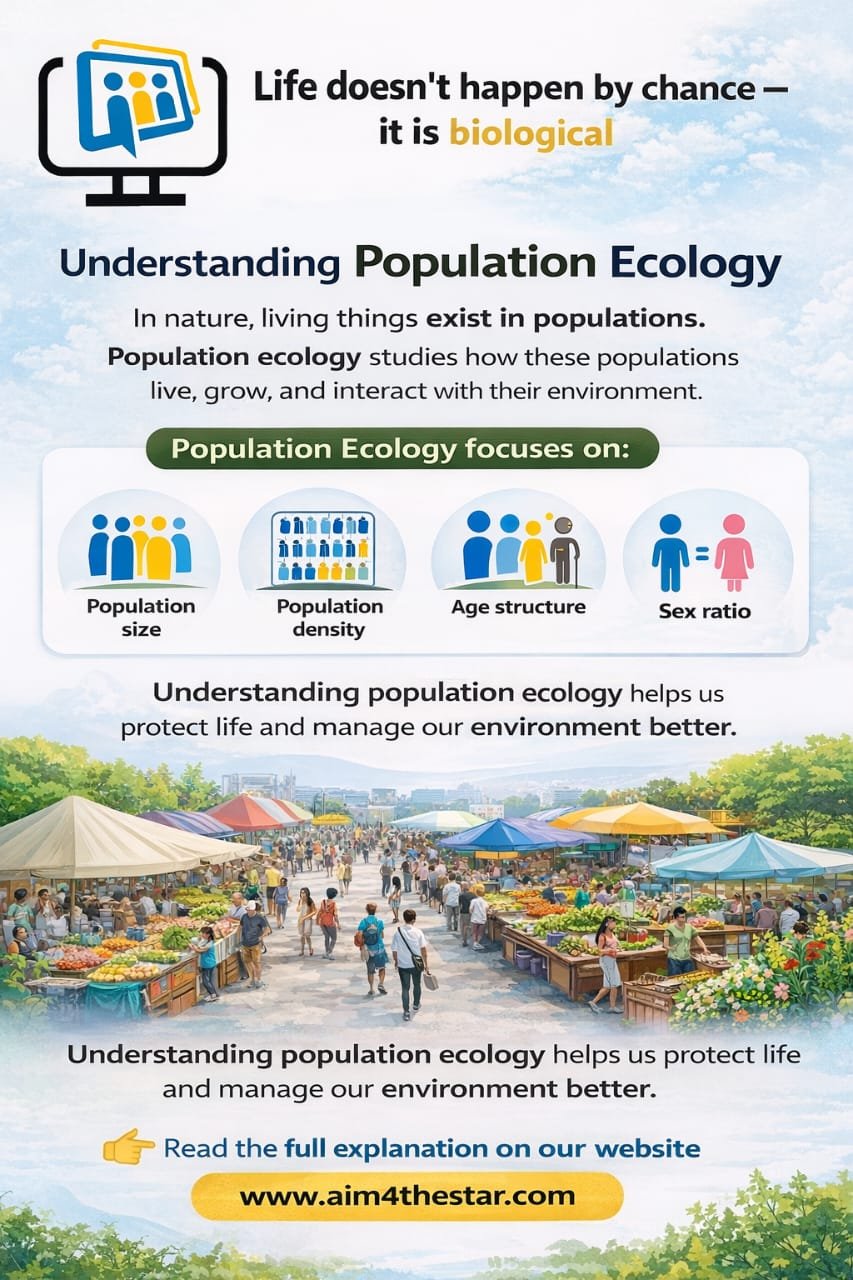
Imagine a busy market filled with people, sellers and goods. That crowd represents a population of humans in one location. In nature, animals, plants, and microorganisms also exist in populations.
Studying how these populations live, grow, and interact is what population ecology is all about.
A Population refers to a group of individuals of the same species living in a specific area at the same time. While Population ecology is the study of how populations of living organisms interact with their environment and how their numbers change over time.
Population ecology is the branch of ecology that studies populations in relation to their environment. It examines factors like population size, density, dispersion patterns, demographic and population growth.
Characteristics of a Population:
Population size: This is the total number of individuals organisms in a population
Population Density: Is measured as the number of individuals per unit area.
Age structure: The proportion of young, mature, and old individuals in a population.
Sex Ratio: The number of males compared to females in a population
Importance of Population Ecology:
Conservation Biology: It identifies threats to biodiversity and efforts to protect endangered species.
Natural Resource Management:
This helps to determine maximum sustainable yields for fishing, hunting, and forestry, ensuring resources are not depleted.
Environmental Change Prediction:
Population ecology helps to forecast how ecosystems will respond to climate change, habitat loss, or pollution, which may cause populations to decline or shift their range.
Human Health and Disease Control:
It is used to analyze the spread of infectious diseases in human and animal populations, helping in developing vaccines and intervention strategies.
Understanding Species Distribution:
This explains why certain species occupy specific habitats and how their density affects their survival.
Consequently, population ecology is the study of how populations of living things interact with their environment and change over time. It looks at characteristics like size, density, distribution, and growth. Population growth is influenced by births, deaths, immigration and emigration.
Studying how these populations live, grow, and interact is what population ecology is all about.
A Population refers to a group of individuals of the same species living in a specific area at the same time. While Population ecology is the study of how populations of living organisms interact with their environment and how their numbers change over time.
Population ecology is the branch of ecology that studies populations in relation to their environment. It examines factors like population size, density, dispersion patterns, demographic and population growth.
Characteristics of a Population:
Population size: This is the total number of individuals organisms in a population
Population Density: Is measured as the number of individuals per unit area.
Age structure: The proportion of young, mature, and old individuals in a population.
Sex Ratio: The number of males compared to females in a population
Importance of Population Ecology:
Conservation Biology: It identifies threats to biodiversity and efforts to protect endangered species.
Natural Resource Management:
This helps to determine maximum sustainable yields for fishing, hunting, and forestry, ensuring resources are not depleted.
Environmental Change Prediction:
Population ecology helps to forecast how ecosystems will respond to climate change, habitat loss, or pollution, which may cause populations to decline or shift their range.
Human Health and Disease Control:
It is used to analyze the spread of infectious diseases in human and animal populations, helping in developing vaccines and intervention strategies.
Understanding Species Distribution:
This explains why certain species occupy specific habitats and how their density affects their survival.
Consequently, population ecology is the study of how populations of living things interact with their environment and change over time. It looks at characteristics like size, density, distribution, and growth. Population growth is influenced by births, deaths, immigration and emigration.
Comments
No comments yet. Be the first to comment!

 Chat with us