The wonders of Mathematics
By Aim4theStars | 21 Jan 2026
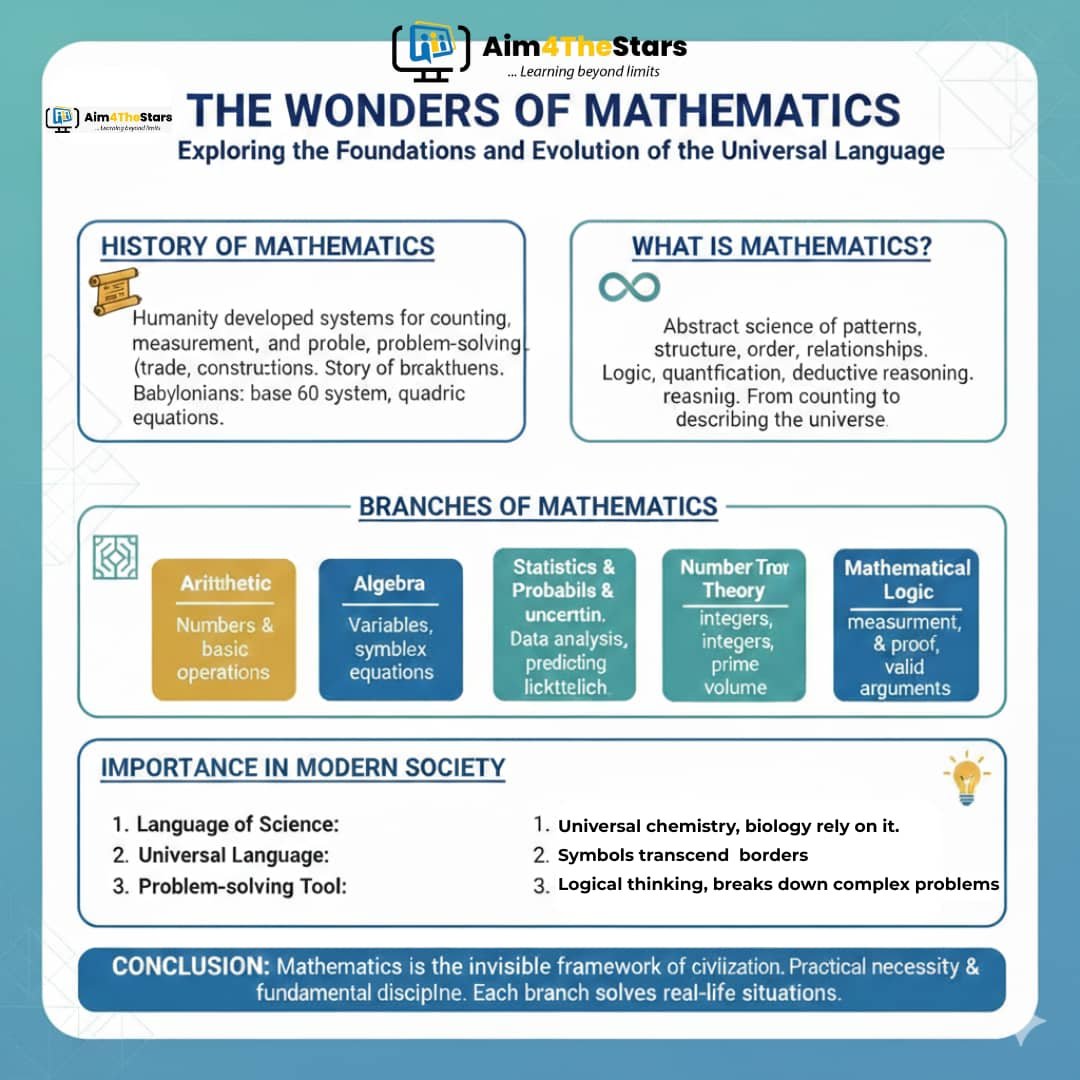
Exploring the foundations and evolution of what is often described as the Universal Language 'Mathematics'. We must first look at its lineage.
The History of Mathematics is a fascinating chronicle of how humanity developed systems for counting, measurement, and problem-solving to meet practical needs such as trade, construction, and record keeping. It is not merely a static collection of rules, but a 'story of brilliant breakthroughs' and cross-cultural exchanges.
For instance, we owe our modern measurement of time and circles to the Babylonians, who mastered quadratic equations and utilised a base 60 systems.
So, how do we define our field? Mathematics is the abstract science of patterns, structure, order, and relationships. It is a rigorous discipline built upon logic, quantification, and deductive reasoning.
While it began with the simple act of counting, it has evolved into a sophisticated toolset for describing the very fabric of the universe.
As we progress in our studies, you will find that mathematics is categorised into several distinct branches, each serving a unique purpose in understanding the world:
Arithmetic:
Arithmetic is the essential foundation that focuses on numbers and basic operations.
Algebra:
This branch introduces variables, letters and symbols to represent numbers, allowing us to form and solve complex equations.
Statistics and Probability:
These fields allow us to manage the tangible and the uncertain. Statistics involve the analysis and interpretation of data while Probability provides the framework for predicting the likelihood of events.
Number Theory:
A more abstract branch that examines the properties of integers including the study of prime numbers.
Mensuration:
This is the study of geometric measurement, specifically the length, area, and volume of various shapes and solids.
Mathematical Logic:
Here, we focus on the mechanics of reasoning and proof, which trains the mind to construct valid, step-by-step arguments.
One might ask why this pursuit is so vital to modern society. Beyond being a tool for problem-solving, mathematics is important in the following ways:
Language of science:
Mathematics serves as a field of study to other subjects such as physics, chemistry, and biology which rely on it to formulate laws and model outcomes.
Mathematics as a Universal language:
Its symbols and formulas transcend cultural borders, fostering global collaboration.
Tools for Problem-solving:
It teaches logical thinking, breaks down complex problems, and identifies patterns.
In conclusion, mathematics is the invisible framework supporting modern civilization. It is both a practical necessity for navigating the world and a fundamental discipline for training the human mind to think with clarity and logic. As we move forward, remember that each branch we study plays a vital role in solving real-life situations.
The History of Mathematics is a fascinating chronicle of how humanity developed systems for counting, measurement, and problem-solving to meet practical needs such as trade, construction, and record keeping. It is not merely a static collection of rules, but a 'story of brilliant breakthroughs' and cross-cultural exchanges.
For instance, we owe our modern measurement of time and circles to the Babylonians, who mastered quadratic equations and utilised a base 60 systems.
So, how do we define our field? Mathematics is the abstract science of patterns, structure, order, and relationships. It is a rigorous discipline built upon logic, quantification, and deductive reasoning.
While it began with the simple act of counting, it has evolved into a sophisticated toolset for describing the very fabric of the universe.
As we progress in our studies, you will find that mathematics is categorised into several distinct branches, each serving a unique purpose in understanding the world:
Arithmetic:
Arithmetic is the essential foundation that focuses on numbers and basic operations.
Algebra:
This branch introduces variables, letters and symbols to represent numbers, allowing us to form and solve complex equations.
Statistics and Probability:
These fields allow us to manage the tangible and the uncertain. Statistics involve the analysis and interpretation of data while Probability provides the framework for predicting the likelihood of events.
Number Theory:
A more abstract branch that examines the properties of integers including the study of prime numbers.
Mensuration:
This is the study of geometric measurement, specifically the length, area, and volume of various shapes and solids.
Mathematical Logic:
Here, we focus on the mechanics of reasoning and proof, which trains the mind to construct valid, step-by-step arguments.
One might ask why this pursuit is so vital to modern society. Beyond being a tool for problem-solving, mathematics is important in the following ways:
Language of science:
Mathematics serves as a field of study to other subjects such as physics, chemistry, and biology which rely on it to formulate laws and model outcomes.
Mathematics as a Universal language:
Its symbols and formulas transcend cultural borders, fostering global collaboration.
Tools for Problem-solving:
It teaches logical thinking, breaks down complex problems, and identifies patterns.
In conclusion, mathematics is the invisible framework supporting modern civilization. It is both a practical necessity for navigating the world and a fundamental discipline for training the human mind to think with clarity and logic. As we move forward, remember that each branch we study plays a vital role in solving real-life situations.
Comments
No comments yet. Be the first to comment!

 Chat with us